
Read Our Letter to the Metropolitan Washington Airports Authority
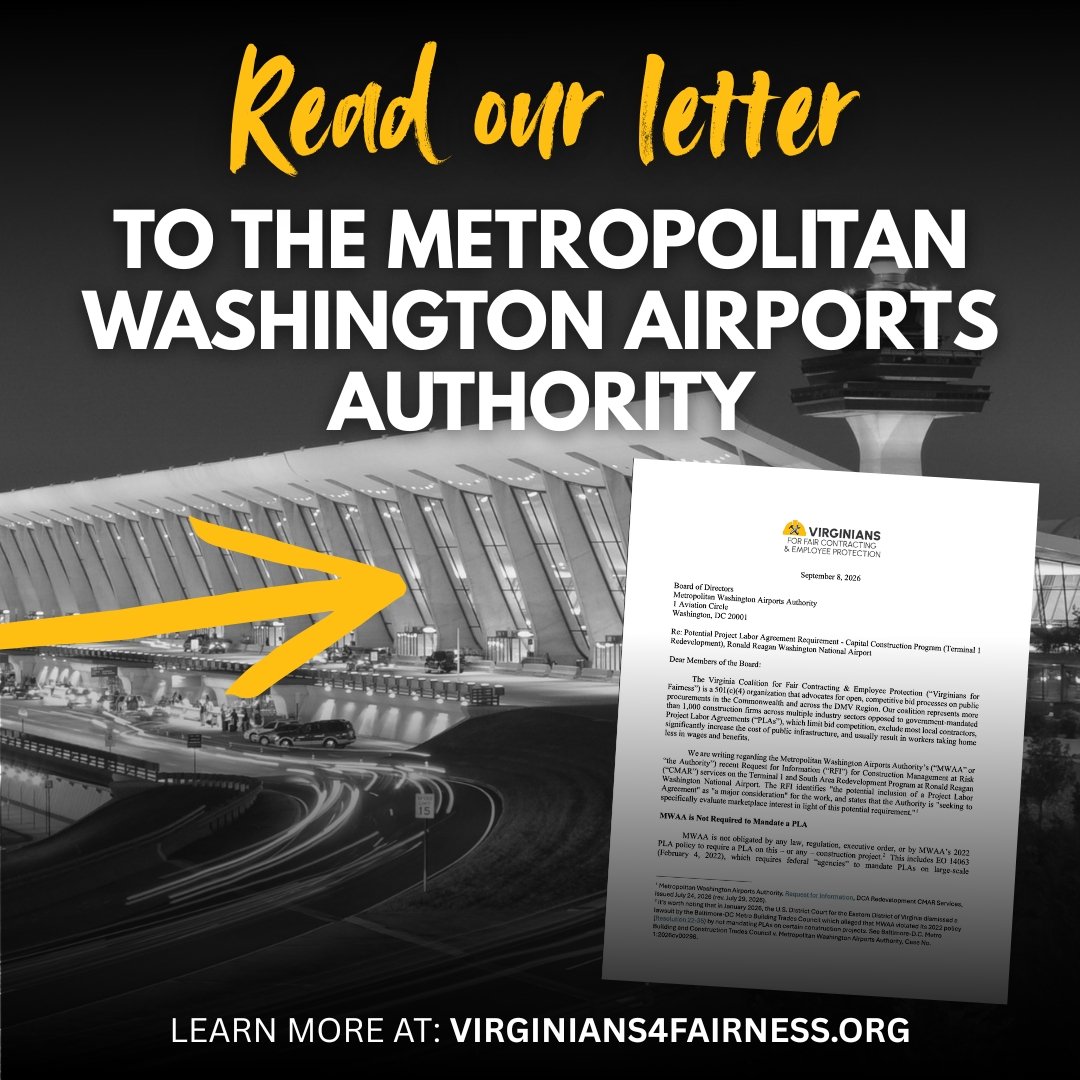
Download a copy here:
Dear Jack:
The Virginia Coalition for Fair Contracting & Employee Protection (“Virginians for Fairness”) is a 501(c)(4) organization that advocates for open, competitive bid processes on public procurements in the Commonwealth and across the DMV Region. Our coalition represents more than 1,000 construction firms across multiple industry sectors opposed to government-mandated Project Labor Agreements (“PLAs”), which limit bid competition, exclude most local contractors, significantly increase the cost of public infrastructure, and usually result in workers taking home less in wages and benefits.
We are writing regarding the Metropolitan Washington Airports Authority’s (“MWAA” or “the Authority”) recent Request for Information (“RFI”) for Construction Management at Risk (“CMAR”) services on the Terminal 1 and South Area Redevelopment Program at Ronald Reagan Washington National Airport. The RFI identifies "the potential inclusion of a Project Labor Agreement" as "a major consideration" for the work, and states that the Authority is "seeking to specifically evaluate marketplace interest in light of this potential requirement."[1]
MWAA is Not Required to Mandate a PLA
MWAA is not obligated by any law, regulation, executive order, or by MWAA’s 2022 PLA policy to require a PLA on this – or any – construction project.[2] This includes EO 14063 (February 4, 2022), which requires federal “agencies” to mandate PLAs on large-scale construction projects. [3][4] Further, the EO makes clear that a non-federal agency, such as MWAA, receiving federal funds or assistance for a large-scale construction project is not subject to the EO’s PLA requirement.[5] There can be no confusion about this: MWAA is not bound by any law, regulation, or other requirement to mandate a PLA on the Authority’s construction procurements.
MWAA Should Enforce Its Ethics Policy on PLA Matters
We are also concerned that a conflict of interest with Board Member Samuel Epps IV would exist on any Board matter involving PLAs. While we are not alleging that Mr. Epps has committed any violation to date, his participation in Board discussions, public or private, about the propriety of PLAs, a PLA requirement, or simply what MWAA’s PLA policy should be, would directly violate MWAA’s Code of Ethics.[6] Mr. Epps is currently the President of the Metro Washington Council, AFL-CIO, where he receives an annual salary. The Council’s membership includes at least 14 unions that are members of the Baltimore-DC Metro Building Trades Council and would be signatories to an MWAA-mandated PLA. We encourage MWAA to ensure its ethics policy is strictly adhered to and enforced as it pertains to this issue.
PLAs Add Unnecessary Costs and Shut Out Qualified Local Contractors
The fact that MWAA is asking contractors about their willingness to engage in a project with a PLA mandate is telling. MWAA’s procurement professionals are rightly concerned that a PLA is certain to discourage otherwise qualified firms from competing for this work. That means fewer bidders and higher costs in an economy already challenged by inflation and tariffs. Independent, peer-reviewed analysis of PLAs confirms the inflationary impact of PLA mandates. Thus, we urge the Authority to keep the project open to all qualified firms.
When Loudoun County surveyed contractors that had previously performed county work, more than half reported that they would not bid on projects subject to a PLA mandate.[7] That result is not surprising. PLAs require contractors and subcontractors to operate with union-assigned employees, instead of their own workforce, working under union-dictated terms. For merit shop contractors, these requirements contain substantial financial and operational risks, including uncapped pension withdrawal liability, duplicative benefit costs, and safety concerns. This is why nearly all non-union contractors will simply not bid on a PLA job.
Independent research confirms the consequences of this reduced bid competition. In 2021 and 2024, the RAND Corporation examined PLA requirements on affordable-housing construction in Los Angeles and found that they increased project costs by approximately 21% and extended completion times by approximately 27%.[8] Although RAND’s research focused on affordable housing, the mechanism driving those additional costs — reduced bid competition — applies to construction procurements generally.
A PLA would also disadvantage most local construction workers. Approximately 95% of Virginia's construction workforce, 80% of the District's construction workforce, and 90% of Maryland's construction workforce does not belong to a union.[9] Under a PLA, those workers may be required to pay union dues or fees and may lose the value of employer contributions made to union benefit plans in which they will never vest. Virginians for Fairness has compared what workers actually receive under PLAs with the wages and benefits available under standard prevailing-wage requirements. In almost every trade examined, workers’ actual wages and benefits were lower under the PLA. A copy of that analysis is attached.
The higher costs and the harm to local workers and businesses associated with PLA mandates have caused a number of Democratic executives to oppose them in recent years. In California, Governor Gavin Newsom vetoed Senate Bill 984, stating that the extra costs of PLA mandates would eat into other state priorities.[10] In Maine, Governor Janet Mills vetoed L.D. 1847 because she believed a PLA would freeze out local contractors and their workers.[11] In nearby Delaware, the Democratically controlled legislature recently killed Senate Bill 272 because, as House Majority Leader Evelyn Harris explained, lawmakers could not get clear answers on what the mandate would cost, with one school district warning it would add "tens of millions of dollars" to its construction plans, or on whether it would keep the work local.[12]
And finally, closer to home, District of Columbia Mayor Muriel Bowser has chastised the DC Council for lowering the threshold that forces its PLA mandate onto more projects, driving up project costs to levels the District cannot afford. The District’s own Chief Financial Officer put a number on it, finding that a PLA “adds about 10% to the cost of each construction project.”[13] Bowser has been just as blunt about who benefits. At one point during the Council’s deliberations on RFK, Bowser said that the promises of PLA proponents to hire District residents “have been made previously and not met on our projects, not on the Frederick Douglass Memorial Bridge, not at Nats Park and not at the hospital. That's a fact.”[14]
Any MWAA PLA is Likely to Violate Virginia Law
Any PLA imposed at Reagan National Airport or Dulles International Airport is likely to run directly afoul of Virginia’s Right to Work law, which specifically prohibits any agreement “whereby any such union or organization acquires an employment monopoly in any enterprise.”[15] In fact, participating in such an agreement is a misdemeanor under Virginia law. Does MWAA really want to force contractors to commit a crime by engaging in an “illegal combination or conspiracy” by being party to a PLA?[16]
In summary, a PLA will leave MWAA with less competition, higher costs, fewer opportunities for the local contractors and workers, and is likely illegal under Virginia law. There is no justification for imposing that result on this important project. We respectfully urge the Authority to keep the future procurement open and competitive for all qualified firms. Thank you for your time and consideration. We would welcome the opportunity to discuss these concerns further and serve as a resource to the Authority as it develops its procurement strategy.
Sincerely,
THE VIRGINIA COALITION FOR FAIR CONTRACTING & EMPLOYEE PROTECTION
[1] Metropolitan Washington Airports Authority, Request for Information, DCA Redevelopment CMAR Services, issued July 24, 2026 (rev. July 29, 2026).
[2] It’s worth noting that in January 2026, the U.S. District Court for the Eastern District of Virginia dismissed a lawsuit by the Baltimore-DC Metro Building Trades Council which alleged that MWAA violated its 2022 policy (Resolution 22-35) by not mandating PLAs on certain construction projects. See Baltimore-D.C. Metro Building and Construction Trades Council v. Metropolitan Washington Airports Authority, Case No. 1:2026cv00296.
[3] Executive Order 14063 – Use of Project Labor Agreements for Federal Construction Projects
[4] The EO defines “Agency” as, an executive department or agency, including an independent establishment subject to the Federal Property and Administrative Services Act, 40 U.S.C. 102(4)(A). This expressly excludes MWAA lending the EO of no consequence its independent procurement authority.
[5] See Sec 7: “Nothing in this order precludes an agency from requiring the use of a project labor agreement in circumstances not covered by this order, including…projects receiving any form of Federal financial assistance (including loans, loan guarantees, revolving funds, tax credits, tax credit bonds, and cooperative agreements).” If nothing in the order precludes an agency from requiring a PLA for non-covered projects receiving federal assistance, then by definition nothing in the order requires a PLA for non-covered projects receiving federal assistance.
[6] Section VI.D of the MWAA Code of Ethics for Members of the Board of Directors requires Directors to recuse themselves from participation in any matter where they have a direct or apparent conflict of interest.
[7] Loudoun County Contractor Survey Results.
[8] Ward, Jason M., "The Effects of Project Labor Agreements on Affordable Housing: Evidence from Proposition HHH," RAND Corporation, 2021 and "Project Labor Agreements and Affordable Housing Production Costs in Los Angeles," RAND Corporation, 2024.
[9] U.S. Bureau of Labor Statistics, Current Population Survey, 2024.
[10] Virginians for Fairness, "CA Governor Gavin Newsom (D) Vetoes PLA Bill Over Costs," October 2, 2024.
[11] Janet T. Mills, veto message regarding L.D. 1847, “An Act to Modify the Visual Impact Standards for Offshore Wind Port Development,” June 26, 2023.
[12] Virginians for Fairness, “Delaware Kills Statewide PLA Mandate Over Cost and Jobs Concerns,” August 6, 2026.
[13] Letter from Mayor Muriel Bowser to the Council of the District of Columbia re: Bill 25-469 (July 2024).
[14] “Bowser, Zachary Parker Debate Union Jobs at Proposed RFK Stadium,” WUSA9 (July 30, 2025).
[15] Code of Virginia, § 40.1-59
[16] Id.