
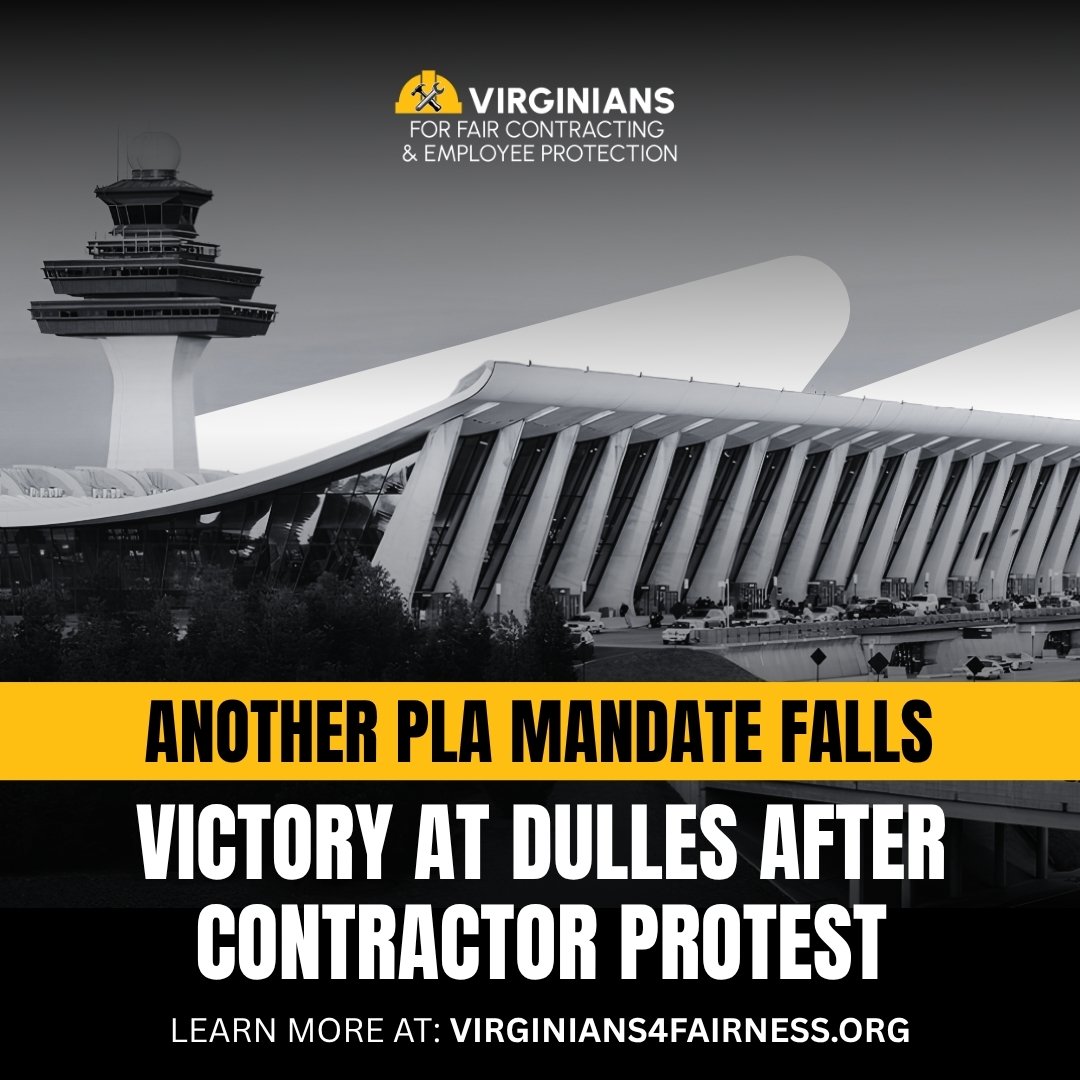
On October 27, the Metropolitan Washington Airports Authority (MWAA) removed the government-mandated Project Labor Agreement (PLA) from its estimated $225 million Dulles runway reconstruction project after contractors challenged the requirement.
Amendment 2 leaves no ambiguity:
“Section VII: Provision 66 Project Labor Agreement (PLA) is deleted in its entirety.”
It also extends the proposal deadline to November 13, giving contractors additional time to compete without the mandate. The contractors asked MWAA to remove the PLA requirement and extend the bidding period. They secured both.
Being qualified to rebuild a runway should have been enough. The original solicitation required the winning contractor and its subcontractors to enter into PLAs before construction could begin. MWAA imposed that condition “at its discretion,” citing a desire to deliver the project on time without labor disruptions.
Allan Myers, William A. Hazel, and Creative Design Concepts formally challenged the mandate, arguing that it violated MWAA’s own competition rules, federal law, and Virginia’s Right to Work laws. These contractors wanted to compete. MWAA’s mandate stood in their way. All three identified work that matched their expertise and said they intended or expected to pursue it without the PLA requirement.
The contractors knew their crews, their productivity, and what it would cost to perform the work. Their challenge warned that union hiring arrangements and work rules could disrupt those established practices. Contractors could also face payments into union benefit funds on top of existing employee benefits, while pricing work under labor terms that had not yet been negotiated.
A contractor’s experience, workforce, and ability to deliver should strengthen its bid. Government should not impose a condition that makes those advantages harder to use.
But what labor-disruption problem was MWAA trying to solve? The contractors pointed out that the Authority had not disclosed research supporting the runway mandate. Yet MWAA made the start of construction dependent on negotiating a PLA. It invoked labor peace without identifying the problem it needed to fix, then imposed a requirement that could itself delay construction.
This is another defeat for government-mandated PLAs in the region. Loudoun County canceled its office building procurement after contractors sued over its PLA requirement. Maryland scrapped the PLA requirement for the Key Bridge reconstruction, and an appeals board found that a separate highway PLA mandate violated procurement law and restricted competition. Now MWAA has backed down at Dulles.
Public officials should stop imposing these mandates instead of waiting for a court to strike them down or a contractor challenge to force a retreat. The pattern is clear, and there is no excuse for repeating it.
Qualified contractors should not have to fight for a fair chance to compete. Public officials should be encouraging more bids, not imposing conditions that drive capable firms away. Open competition should be the starting point for public procurement, not a concession won after a fight.