
MWAA Puts PLA on the Table for Major Reagan National Redevelopment
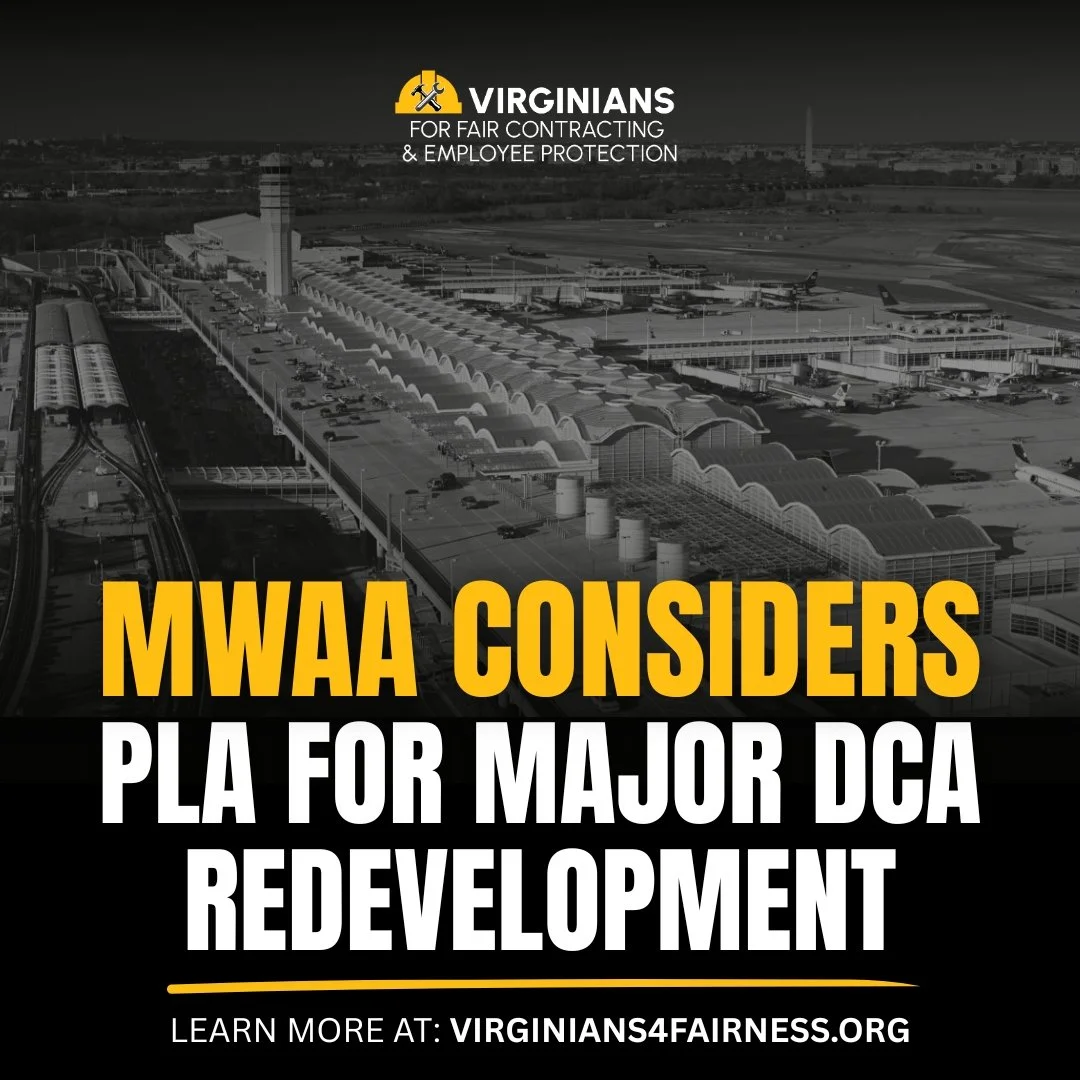
MWAA is asking contractors whether a Project Labor Agreement would affect their willingness to bid on the Terminal 1 redevelopment - the same kind of union mandate the authority abandoned on the Silver Line.
Read the RFI here: RFI: DCA Redevelopment CMAR Services
The Metropolitan Washington Airports Authority (MWAA) is floating a Project Labor Agreement on one of the largest construction programs in Reagan National's history. In a Request for Information issued July 24 and revised July 29, MWAA tells contractors that “a major consideration for this requirement is the potential inclusion of a Project Labor Agreement (PLA),” and asks each firm whether a PLA “would impact the firm's decision to participate in a future solicitation.”
The RFI - covering construction management for the Terminal 1 and South Area redevelopment at Reagan National (DCA) - states that the work will be “contracted, managed, and funded” by MWAA itself. MWAA is presenting a PLA here as its own procurement choice, not as an existing mandate already attached to the work.
It's a choice MWAA has made before and then reversed. In April 2011, the MWAA board voted to require a PLA on Phase 2 of the Silver Line. After a year of opposition from Virginia officials, funding partners, and the Commonwealth's construction industry, the board dropped the mandate, briefly replaced it with a 10% union-bid “preference,” and then scrapped that too in an 11-1 vote.
Once the contract was opened to full competition, the winning bid came in at about $1.18 billion - well below MWAA's own $1.4-to-$1.6 billion estimate. Opening the job to every qualified contractor didn't slow the project down. It brought the price down.
The landscape has shifted since then. In 2020, the General Assembly amended the Virginia Public Procurement Act to let public bodies require PLAs - reversing the Commonwealth's earlier prohibition - and unions have pressed to mandate them on projects across Virginia ever since. That's exactly why this RFI is worth watching closely: the guardrails that checked MWAA's last PLA push are not what they were.
The evidence against these mandates, however, hasn't changed. Independent studies consistently find that PLAs raise public construction costs by shrinking competition and piling on union work rules. The federal government's own procurement arm has admitted as much, conceding that PLAs bring “higher costs and limited competition” - and federal courts have repeatedly struck down PLA mandates for violating the Competition in Contracting Act.
That case is even stronger in Virginia - a right-to-work state where union membership runs far below the national average and the construction workforce is overwhelmingly merit shop. A PLA on this project would let union hiring halls decide who gets to work on it, shutting out the Virginia contractors and workers who make up the vast majority of that market.
MWAA already ran this experiment once and learned what open competition is worth. Virginia's leaders shouldn't let it charge taxpayers to relearn the same lesson. Contractor responses are due Friday, August 7 - MWAA should take the PLA off the table before this goes any further.