
Federal Data Disprove Claims that Government-Mandated PLAs Increase Worker Safety in Virginia
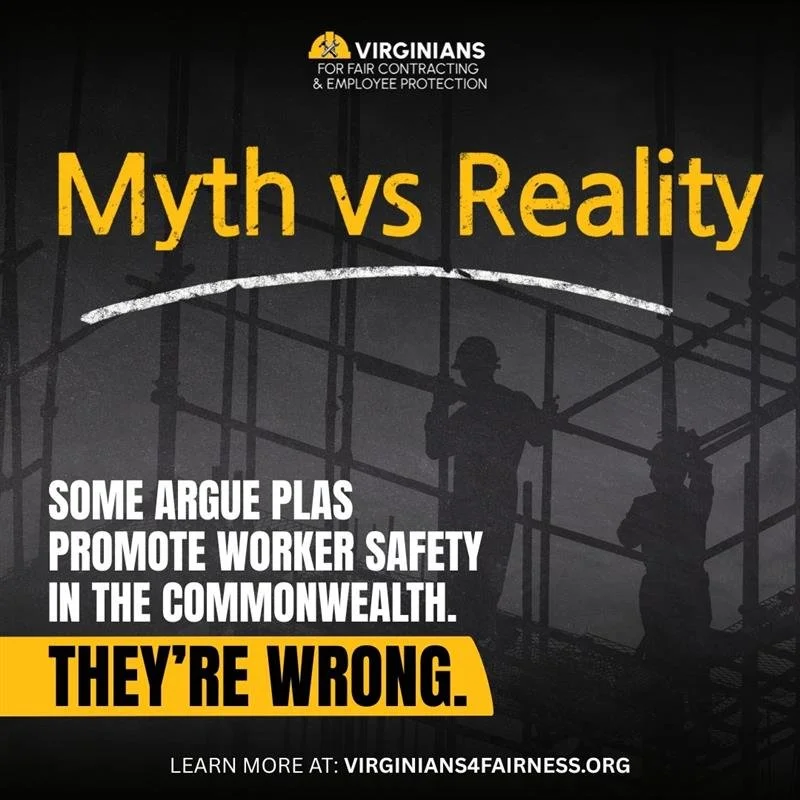
Download a copy of our analysis here.
Project Labor Agreements and Construction Safety: What the Data Show
Advocates for Project Labor Agreements (“PLAs”) in Virginia frequently claim that the added costs of these political mandates are worth it because PLAs increase worker safety and reduce workplace injuries in the Commonwealth. We examined this claim, starting with an examination of where Virginia ranks vis-à-vis other states when it comes to worker safety in construction. If the claim that PLAs increase safety were correct, states with low union participation would reasonably be expected to exhibit higher rates of serious construction injuries. Our analysis of available federal data, however, directly contradicts the talking points of PLA proponents.
In fact, data from the U.S. Bureau of Labor Statistics’ Survey of Occupational Injuries and Illnesses (SOII) show that Virginia is among the safest states for construction in the United States. SOII provides employer-reported injury incidence rates using standardized Occupational Safety and Health Administration (OSHA) recordkeeping definitions, allowing for consistent comparisons across participating states. Because these data are reported as incidence rates per 100 workers rather than raw injury counts, they account for differences in workforce size and industry scale among states.
For 2024, BLS publishes state-level private construction incidence rate data for 43 states. These measures include serious construction injuries, such as cases that require time away from work. Lower incidence rates on these measures reflect stronger safety performance. Virginia, which is a right-to-work state with relatively low union participation in construction, ranks 11th lowest in total recordable cases, 8th lowest in days away from work, and 9th lowest in the most severe injuries[1]. The data are clear: there is no construction worker safety crisis in Virginia.
| Metric | What it Measures | Virginia Rate | Where Virginia Ranks |
|---|---|---|---|
| Total Recordable Cases (TRC) |
All recordable injuries | 1.6 | 11th lowest |
| Days Away/Restricted/Transferred (DART) |
Serious injuries that remove workers from the job or restrict their ability to perform normal duties | 0.9 | 8th lowest |
| Days Away From Work (DAFW) |
Most severe injuries resulting in days away from work | 0.6 | 9th lowest |
What About Highly Unionized States?
To evaluate the claim that higher unionization leads to improved safety outcomes, we compared Virginia’s injury rates to those in the three states with the highest union membership in private construction. According to 2024 data from the U.S. Census Bureau’s Current Population Survey (CPS), compiled by UnionStats.com, Hawaii has the highest rate of union membership in private construction at 30.5%. Ohio is the runner-up with 26.2%, and Illinois has the third highest rate at 26.1%[2].
Again, if PLA advocates’ claims about the increased safety of union-only work are to be believed, we would expect to see lower injury rates in these three states. Using 2024 SOII data for private construction, however, that is not what the data show. Instead, Hawaii, Illinois, and Ohio all demonstrate higher levels of construction workplace injuries than Virginia on key nonfatal injury measures[3].
Further, data from the U.S. Bureau of Labor Statistics’ Census of Fatal Occupational Injuries (CFOI) show that in 2023, the most recent year available, the number of workplace fatalities per 100,000 construction workers in Illinois and Ohio was nearly twice as high as Virginia.[4]
| Metric | Virginia Rate | Hawaii Rate | Illinois Rate | Ohio Rate |
|---|---|---|---|---|
| Construction Union Membership (%) | 4.8 | 30.5 | 26.1 | 26.2 |
| Total Recordable Cases (TRC) | 1.6 | 3.9 | 1.5 | 1.8 |
| Days Away/Restricted/Transferred (DART) | 0.9 | 2.9 | 1.2 | 1.0 |
| Days Away From Work (DAFW) | 0.6 | 2.3 | 0.9 | 0.8 |
| Fatality Rate (per 100,000 workers) |
4.6 | --- | 9.8 | 9.5 |
Conclusion
Our analysis of federal SOII and workplace fatality data shows that Virginia does not experience elevated or unusually severe construction injury or fatality rates relative to other states. Instead, Virginia’s construction industry boasts worker safety metrics that compare extremely favorably with those of other states, providing no evidence of a construction injury problem in the Commonwealth. Further, the incidence rates of workplace injuries and fatalities among construction workers in Virginia are lower on nearly every measure than the same rates in the three most highly unionized states (Hawaii, Ohio, and Illinois). This suggests that unionization, and thus the forced unionization inherent in PLAs, does not lead to safer construction sites, and it may even suggest the opposite.
###
[1] U.S. Bureau of Labor Statistics, Survey of Occupational Injuries and Illnesses (SOII), 2024, NAICS 23 – Private Construction.
[2] U.S. Census Bureau, Current Population Survey (CPS), By Sector and State, compiled by UnionStats.com (private construction union membership rates).
[3] U.S. Bureau of Labor Statistics, Survey of Occupational Injuries and Illnesses (SOII), 2024, NAICS 23 – Private Construction.
[4] U.S. Bureau of Labor Statistics, Census of Fatal Occupational Injuries (CFOI), 2023, NAICS 23. Hawaii did not report construction-specific fatality rate data for 2023.